
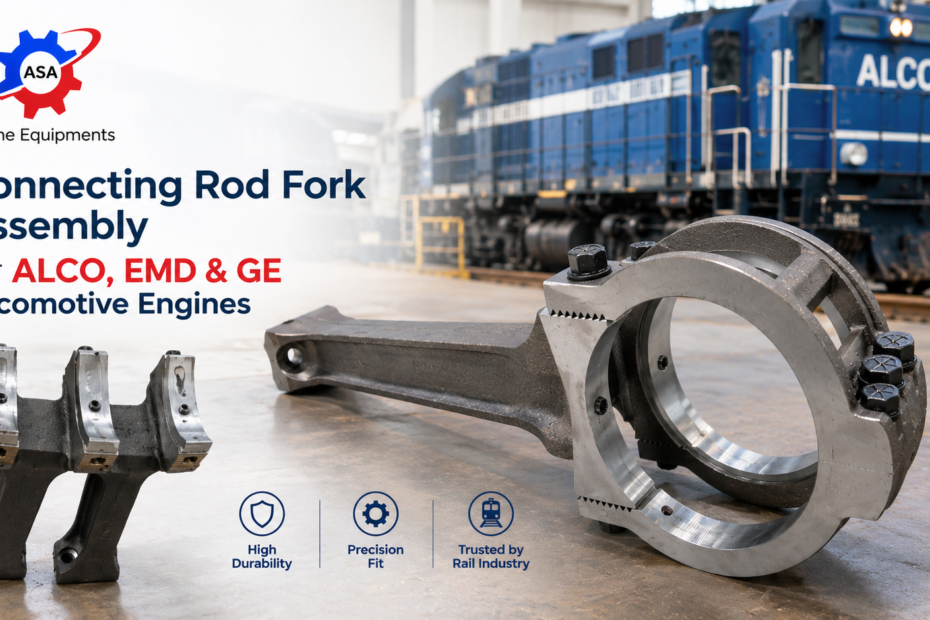
Diesel locomotive engines built by ALCO, EMD, and GE all share one common engineering challenge: efficiently transmitting the force of combustion from multiple pistons onto a single crankpin. This is precisely where the Connecting Rod Fork Assembly comes in. Because these engines are typically arranged in V-configuration cylinder banks, a single crankpin must accommodate two connecting rods simultaneously — and that’s only possible through a fork-and-blade design.
In this guide, we’ll explore what a connecting rod fork assembly is, how it works, the specifications that matter most, and why sourcing this component from a trusted supplier is essential for railroad, marine, and power sector operators.
What Is a Connecting Rod Fork Assembly?
A Connecting Rod Fork Assembly is a paired connecting rod system used in V-type diesel engines, including many ALCO, EMD, and GE locomotive models. Essentially, one rod — called the “fork” rod — splits into two arms at its big end, while the second rod — the “blade” rod — fits precisely between those arms. Together, they share a single crankpin journal, allowing two pistons on opposite cylinder banks to drive the same point on the crankshaft.
Because both rods operate on the same crankpin, however, their geometry must be manufactured with extreme precision. Otherwise, misalignment can cause uneven load distribution, premature bearing wear, or even catastrophic engine failure.
How It Works
As the piston on the fork-rod side moves, it transmits force through the forked arms onto the crankpin. Simultaneously, the blade rod — nested between the fork arms — transmits force from its own piston onto the same crankpin location. As a result, this configuration allows compact, high-power V-engine designs without requiring a separate crankpin for every cylinder, which in turn reduces crankshaft length, weight, and overall engine footprint.
Why the Connecting Rod Fork Blade Design Matters
The Connecting Rod Fork Blade design is not just a space-saving solution — it’s central to how ALCO, EMD, and GE V-type engines achieve their power-to-weight ratios. Consequently, any dimensional inaccuracy in this assembly can directly affect engine balance, vibration levels, and long-term reliability.
For this reason, railroad operators and rebuilders consistently look for suppliers who understand the specific tolerances required for fork-and-blade assemblies rather than treating them as generic connecting rod replacements.
Common Failure Points
If manufactured or maintained incorrectly, connecting rod fork assemblies can experience:
- Bearing surface wear due to misaligned fork arms
- Fatigue cracking at the fork-to-shank transition under repeated stress cycles
- Uneven crankpin loading, leading to vibration and reduced engine life
- Oil starvation at the bearing interface if oil gallery machining is imprecise
Therefore, quality control at every stage of manufacturing is critical — from forging through final machining and inspection.
Technical Specifications to Look for in a Connecting Rod Fork Assembly
When sourcing a Locomotive Connecting Rod fork-and-blade set, buyers should confirm the following specifications:
- Material grade and forging quality — High-strength forged steel is standard, ensuring fatigue resistance under continuous cyclic loading.
- Big-end bore tolerance — Precision boring ensures proper bearing shell seating and correct clearance on the crankpin.
- Fork arm alignment — The fork arms must be parallel and symmetrically machined to distribute load evenly onto the blade rod.
- Oil gallery machining — Internal oil passages must align correctly to deliver adequate lubrication to the crankpin bearing surface.
- Weight matching — Fork and blade rods should be weight-balanced as a set to minimize vibration across the engine.
- Heat treatment and stress relieving — Proper heat treatment reduces the risk of fatigue cracking at high-stress points.
- Surface finish at bearing bores — A smooth, accurately sized bore is essential for correct bearing fit and oil film retention.
Above all, reputable manufacturers test and certify these assemblies to ISO 9001:2015 standards, ensuring consistency across every batch supplied.
Applications of Connecting Rod Fork Assemblies
Connecting rod fork assemblies are used wherever V-type diesel engines are found. Below are the primary applications.
Railroad Locomotive Engines
ALCO and EMD locomotive engines, in particular, widely use fork-and-blade connecting rod configurations in their V12, V16, and V20 cylinder arrangements. Consequently, this component is essential to nearly every major overhaul or engine rebuild project involving these engine families.
Marine Diesel Propulsion
Similarly, marine diesel engines derived from locomotive platforms rely on the same fork-and-blade design to achieve compact, high-output propulsion systems suitable for vessel engine rooms with limited space.
Power Generation
In addition, stationary V-type diesel gensets used for backup and industrial power also depend on properly specified connecting rod fork assemblies to maintain balanced, low-vibration operation over long duty cycles.
Engine Rebuild & Overhaul Programs
Furthermore, rebuild shops handling major locomotive overhauls require matched fork-and-blade sets — rather than individual rods — to ensure correct weight balance and bearing clearance across the full engine.
EMD & ALCO Connecting Rod Fork Assembly: Key Differences
While the underlying principle is the same, EMD Connecting Rod Fork assemblies and ALCO Connecting Rod Blade assemblies differ in dimensions, bolt patterns, and bearing specifications based on each manufacturer’s engine architecture. Therefore, it’s essential to source assemblies matched precisely to your engine model rather than assuming interchangeability between EMD, ALCO, and GE platforms.
Why Choose ASA Engine Equipments for Your Connecting Rod Fork Assembly
ASA Engine Equipments has supplied OEM-quality locomotive and marine engine parts for over 20 years, serving railroad operators, rebuilders, and marine industries across the USA, Canada, Australia, Germany, France, UK, Bangladesh, Mexico, Italy, Romania, Austria, Turkey, Mozambique, Sri Lanka, Senegal, and more.
As a trusted source for Connecting Rod Fork Assembly components, ASA works with ISO 9001 / IATF 16949 certified Indian manufacturing partners — many of whom are approved suppliers to Indian Railways (DLW) — to deliver fully machined, precision-matched fork-and-blade rod sets for ALCO, EMD, and GE engines.
What Sets ASA Apart
- 20+ years of industry experience in ALCO, EMD, and GE locomotive parts supply
- OEM equivalent quality at competitive pricing, without compromising on material or tolerances
- 12-month warranty on all supplied parts against material or workmanship defects
- Reverse engineering capability for obsolete or hard-to-source connecting rod variants
- Global export network with reliable lead times for railroad and marine customers worldwide
- Custom parts development based on customer drawings or physical samples
Our Process
- First, the customer shares engine specifications, drawings, or sample parts.
- Next, ASA’s engineering team confirms compatibility and material specifications.
- Then, parts are manufactured and quality-checked by certified manufacturing partners.
- Finally, finished fork-and-blade assemblies are inspected, packed, and shipped with full documentation.
Maintenance Tips for Connecting Rod Fork Assemblies
To maximize service life once installed, consider the following best practices:
- Follow OEM torque specifications precisely when installing fork and blade rods
- Inspect bearing surfaces during scheduled overhauls for early signs of wear
- Always replace fork and blade rods as matched sets, never individually
- Monitor oil pressure and flow to the crankpin bearing regularly
- Above all, source replacement assemblies only from a verified Connecting Rod Fork Assembly supplier to avoid dimensional mismatches
Conclusion
In short, the Connecting Rod Fork Assembly is a precision-engineered, mission-critical component in ALCO, EMD, and GE locomotive engines. Whether you’re a railroad operator managing a fleet, a rebuilder handling major overhauls, or a marine engineering team maintaining propulsion systems, sourcing accurately matched fork-and-blade rod sets is essential to engine reliability and performance.
Ultimately, ASA Engine Equipments combines two decades of experience, ISO-certified manufacturing partnerships, and a global export network to deliver dependable connecting rod fork assemblies — backed by warranty and technical support — to customers across the railroad, marine, and power sectors.
Contact ASA Engine Equipments today to discuss your connecting rod fork assembly requirements and request a quote tailored to your engine specifications.