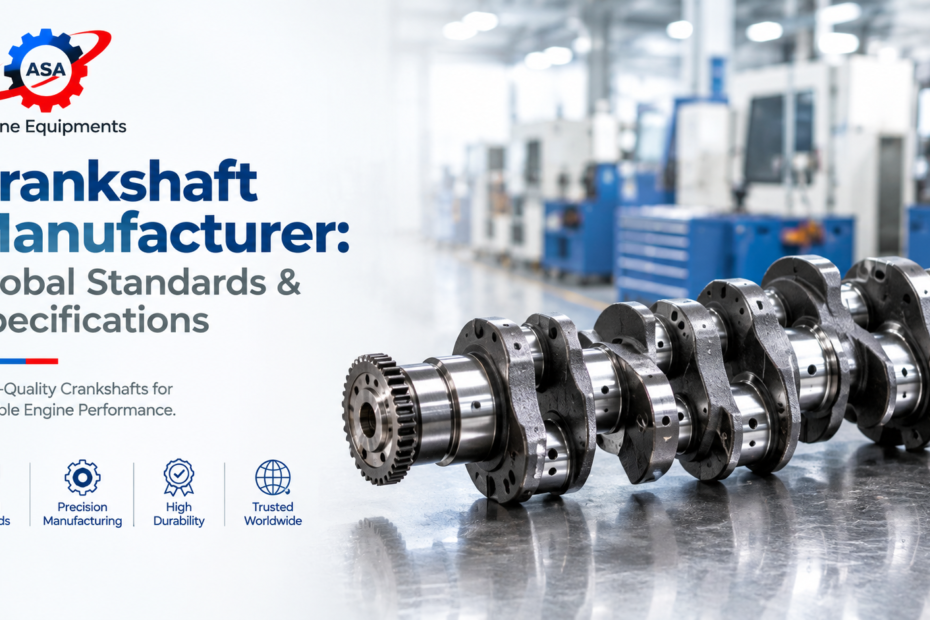
Choosing the right crankshaft manufacturer is one of the most important decisions a railroad operator or rebuilder can make. As the component that converts the up-and-down motion of pistons into the rotational force that ultimately drives the locomotive, the crankshaft endures some of the highest mechanical stress of any part in the engine. For fleets operating across multiple regions and engine platforms, working with a reliable crankshaft manufacturer that follows global quality standards is essential to long-term engine performance.
This guide covers what to look for in a crankshaft manufacturer, the specifications that matter most, and how global standards affect the parts you source for EMD, ALCO, and GE locomotive engines.
What Does a Crankshaft Manufacturer Do?
A crankshaft manufacturer is responsible for forging, machining, and finishing crankshafts to precise engineering tolerances. This process involves shaping high-strength alloy steel into a component capable of withstanding continuous rotational stress, heat, and vibration over thousands of operating hours.
Because crankshafts are custom-engineered to match specific engine bore sizes, stroke lengths, and journal diameters, a crankshaft manufacturer must maintain strict quality control at every production stage — from raw material sourcing to final balancing and inspection.
Why Global Standards Matter
Locomotive fleets operate across vastly different regions, climates, and regulatory environments — from North America to Europe, Australia, and beyond. A crankshaft manufacturer that adheres to internationally recognized standards, such as ISO 9001:2015, ensures consistent quality regardless of where the component is shipped or installed.
Global standards also matter because railroad operators often source parts for engines originally built decades ago. A trusted crankshaft manufacturer must be able to reproduce OEM specifications accurately, even for older EMD, ALCO, and GE engine series that are no longer in active production but remain in service worldwide.
Key Functions of the Crankshaft in Locomotive Engines
The crankshaft sits at the core of the engine, connecting to each piston via connecting rods. As pistons move up and down during combustion, the crankshaft converts this linear motion into rotational energy that ultimately powers the locomotive’s traction system.
Given this critical role, any imbalance, misalignment, or material weakness introduced during manufacturing can lead to excessive vibration, bearing wear, or catastrophic engine failure. This is why selecting an experienced crankshaft manufacturer with proven expertise in locomotive engine components is non-negotiable for fleet reliability.
Specifications to Evaluate in a Crankshaft Manufacturer
Material Grade and Forging Process
High-quality crankshafts are typically forged from alloy steel, offering superior strength and fatigue resistance compared to cast alternatives. A reputable crankshaft manufacturer will use controlled forging processes that align grain structure for maximum durability under cyclical loading.
Journal Diameter and Stroke Length
These measurements must match the exact specifications of the engine platform, whether it’s an EMD 645, ALCO 251, or GE 7FDL series engine. Even minor deviations can cause improper bearing clearance or reduced engine performance.
Balancing and Machining Tolerances
Precision balancing is critical, as crankshafts rotate at high speeds under significant load. A skilled crankshaft manufacturer performs dynamic balancing to minimize vibration, which in turn reduces stress on bearings, seals, and other connected components.
Heat Treatment and Hardening
Surface hardening processes, such as induction hardening on journal surfaces, improve wear resistance at critical contact points. This extends the service life of the crankshaft significantly compared to untreated components.
Quality Certifications
Look for a crankshaft manufacturer that holds recognized certifications and follows documented inspection processes, including dimensional verification, crack detection testing, and material composition analysis.
How to Choose the Right Crankshaft Manufacturer
Verify OEM Compatibility
Confirm that the manufacturer produces crankshafts matching exact OEM dimensions and tolerances for your specific engine model, whether EMD, ALCO, or GE.
Assess Manufacturing Experience
A crankshaft manufacturer with decades of experience in locomotive and industrial engine components is more likely to understand the nuanced demands of heavy-duty rail applications compared to general automotive suppliers.
Request Material Certifications
Reliable suppliers provide documentation confirming alloy composition and heat treatment processes, giving operators confidence in long-term durability.
Evaluate Global Supply Capability
For fleets operating internationally, partnering with a crankshaft manufacturer capable of consistent global delivery reduces lead times and simplifies maintenance planning across multiple locations.
Check Testing and Inspection Protocols
Ask about balancing procedures, crack detection methods, and final inspection standards to ensure every crankshaft meets consistent quality benchmarks before shipment.
Common Crankshaft Failure Points and Manufacturing Impact
Many crankshaft failures trace back to manufacturing shortcuts rather than normal wear. Inadequate forging processes can leave internal stress points that lead to fatigue cracking over time. Poor journal machining tolerances can cause premature bearing wear, while insufficient balancing often results in vibration-related damage to connected engine components.
Working with an experienced crankshaft manufacturer significantly reduces these risks, as proper engineering and quality control address potential failure points before the component ever reaches installation.
Maintenance Considerations Linked to Manufacturing Quality
While crankshafts require less frequent maintenance than components like gaskets or filters, their long-term reliability depends heavily on manufacturing quality. Crankshafts produced by a reputable crankshaft manufacturer typically require less frequent inspection intervals and demonstrate more predictable wear patterns.
Routine oil analysis can help detect early signs of bearing or journal wear, while vibration monitoring can flag balancing issues that may point back to manufacturing inconsistencies rather than operational wear.
The Role of Global Sourcing in Fleet Reliability
Railroad operators managing fleets across multiple countries benefit significantly from working with a single, dependable crankshaft manufacturer capable of serving diverse markets. This reduces variability in part quality across different regions and simplifies inventory management for rebuilders handling multiple locomotive platforms.
A manufacturer with established export experience to the USA, Europe, Australia, and other major rail markets brings valuable insight into regional compliance requirements and operating conditions, ensuring crankshafts perform reliably regardless of climate or duty cycle.
Conclusion
Selecting the right crankshaft manufacturer directly impacts locomotive engine performance, reliability, and long-term operating costs. From material grade and forging quality to precision balancing and global certification standards, every aspect of manufacturing plays a role in how well a crankshaft performs under continuous heavy-duty operation.
By partnering with an experienced, globally capable crankshaft manufacturer, railroad operators and rebuilders can ensure consistent quality across their fleets, reduce unplanned downtime, and extend the operational life of their EMD, ALCO, and GE locomotive engines.