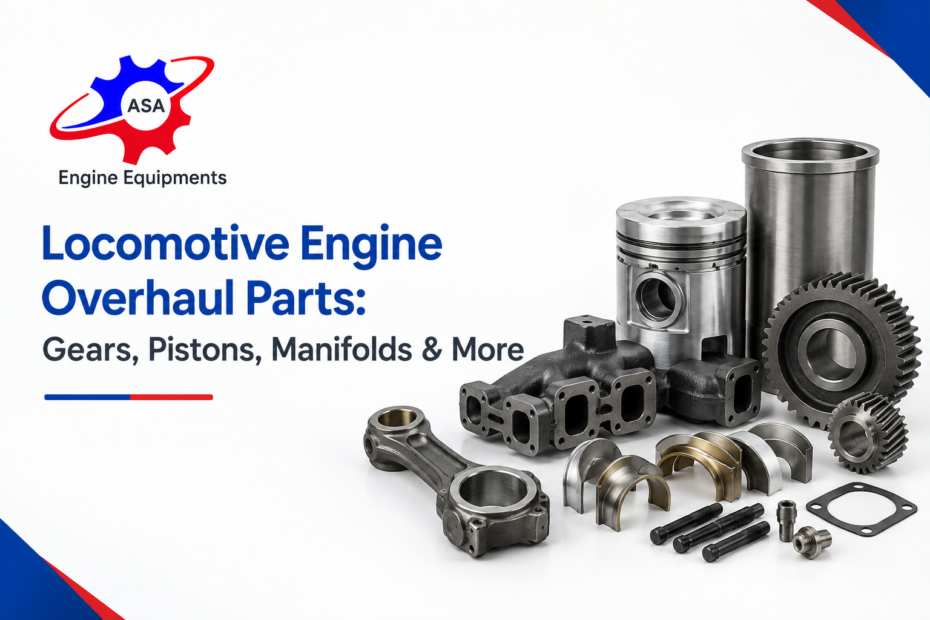
Diesel locomotives run for decades, but they only perform at peak levels when operators schedule regular overhauls and use the right replacement components. Whether you operate a fleet of ALCO, EMD, or GE locomotives, sourcing high-quality Locomotive Engine Overhaul Parts ranks among the most important decisions you’ll make for long-term reliability, fuel efficiency, and reduced downtime.
This guide breaks down the essential components involved in a locomotive engine overhaul, explains why quality matters, and shows you how to choose the right supplier for your railroad or marine operation.
Why Locomotive Engine Overhauls Matter
Locomotive engines endure extreme stress — heavy loads, continuous vibration, high temperatures, and long duty cycles. Over time, even the most robust components wear down. A proper overhaul restores an engine to OEM-equivalent performance, extends its service life by years, and prevents costly unplanned failures in the field.
Skip genuine overhaul kits and precision-machined replacement parts, and you risk reduced horsepower, poor fuel economy, and repeat breakdowns that disrupt railroad schedules or marine operations. That’s why you should source Locomotive Engine Overhaul Parts from an experienced, quality-certified supplier.
Core Components in a Locomotive Engine Overhaul
A complete overhaul typically touches several critical subsystems. Here’s a look at the major parts involved.
Engine Gears & Pinions
Gears and pinions transmit torque throughout the engine assembly. They control speed, torque, and directional power delivery, and even minor wear on gear teeth can throw off an engine’s mechanical efficiency. High-precision Locomotive Gears, manufactured to tight tolerances, ensure smooth power transmission and reduce the risk of premature failure across the drivetrain.
During an overhaul, technicians inspect gears and pinions for pitting, wear patterns, and misalignment. They replace worn components with parts that match OEM specifications exactly, since even slight dimensional deviations can cause vibration, noise, or accelerated wear in mating parts.
Piston Pins and Piston Assemblies
The piston pin connects the piston to the connecting rod and provides a pivot point as the piston moves through its combustion cycle. This component absorbs repeated shock loads with every combustion event, making it one of the highest-stress parts in the entire engine.
Manufacturers build Piston Pins from hardened, wear-resistant materials to withstand years of continuous cycling. During overhaul work, technicians check pin bores for scoring, measure clearances, and replace any components that fall outside tolerance. Installing substandard piston pins quickly compromises an otherwise well-executed overhaul.
Connecting Rods — Fork & Blade Type
Connecting rods transfer the force of combustion from the piston to the crankshaft and convert linear motion into rotational power. Many locomotive engine designs use a fork-and-blade configuration, where one rod forks to straddle a second “blade” rod on the same crank journal.
This design demands exceptional manufacturing precision, since both rods must move in perfect coordination without interference. Connecting rod assemblies rank among the highest-volume, most safety-critical components technicians replace during a major overhaul, and quality control here directly affects engine balance, vibration levels, and long-term durability.
Manifold Assemblies
Exhaust manifold assemblies guide combustion gases away from the cylinders toward a common exhaust chamber, often at temperatures exceeding 600°C. Engineers build these assemblies with expansion joints between segments to absorb thermal and vibrational stress and prevent cracking under extreme heat cycling.
A well-fabricated Manifold Assembly delivers more than just performance — it protects safety and emissions compliance. Corrosion resistance and precise fitment matter especially, since a poorly matched manifold can cause exhaust leaks, reduce turbocharger efficiency, and increase maintenance costs down the line.
Turbocharger Components
Many modern locomotive engines — particularly EMD 645, 710, and 567 series engines — rely heavily on turbocharging systems to achieve their rated horsepower. Constant high-RPM operation and exposure to extreme exhaust temperatures wear down turbocharger components over time.
During an overhaul, technicians inspect turbocharger housings, bearings, and rotating assemblies and replace them as needed to restore boost pressure and combustion efficiency. Skip turbocharger parts during an overhaul, and your engine may run — but never return to its original power output.
What to Look for in a Locomotive Engine Overhaul Parts Supplier
Suppliers vary widely in quality, consistency, and reliability. When you source locomotive engine overhaul parts, look for the following:
- OEM-equivalent specifications — The supplier should manufacture or reverse-engineer parts to match original equipment tolerances exactly.
- ISO-certified manufacturing — Choose suppliers whose manufacturing partners hold ISO 9001 or IATF 16949 certification.
- Engine coverage — A strong supplier stocks parts across major platforms, including ALCO, EMD, and GE engine families.
- Global logistics capability — Railroad and marine operators often need parts shipped internationally with dependable lead times.
- Warranty backing — Reputable suppliers stand behind their parts with a clear warranty against material or workmanship defects.
Why Operators Choose ASA Engine Equipments
For over 20 years, ASA Engine Equipments has supplied locomotive engine parts to railroad operators, rebuilders, and marine industries worldwide. As a specialist in Locomotive Engine Overhaul Parts for ALCO, EMD, and GE engines, ASA partners with ISO 9001 and IATF 16949 certified manufacturers — including approved suppliers to Indian Railways (DLW), EMD, and GE — to deliver fully machined, export-quality components.
ASA Engine Equipments covers everything from engine gears and pinions to piston pins, connecting rods, manifold assemblies, and turbocharger parts, backed by full engineering and manufacturing support, including reverse engineering for hard-to-source or obsolete parts. Every component carries a 12-month warranty against faulty material or workmanship, and the company has completed over 12,000 projects for nearly 1,800 satisfied clients across the USA, Canada, Australia, Europe, and beyond.
Final Thoughts
A successful locomotive engine overhaul depends on more than skilled labor — it depends on sourcing the right parts from a supplier who understands the demands of railroad and marine operations. From gears and piston pins to connecting rods and manifold assemblies, every component plays a role in restoring an engine to peak performance.
If you’re planning an overhaul and need dependable, OEM-quality Locomotive Engine Overhaul Parts, contact ASA Engine Equipments to discuss your ALCO, EMD, or GE engine requirements.