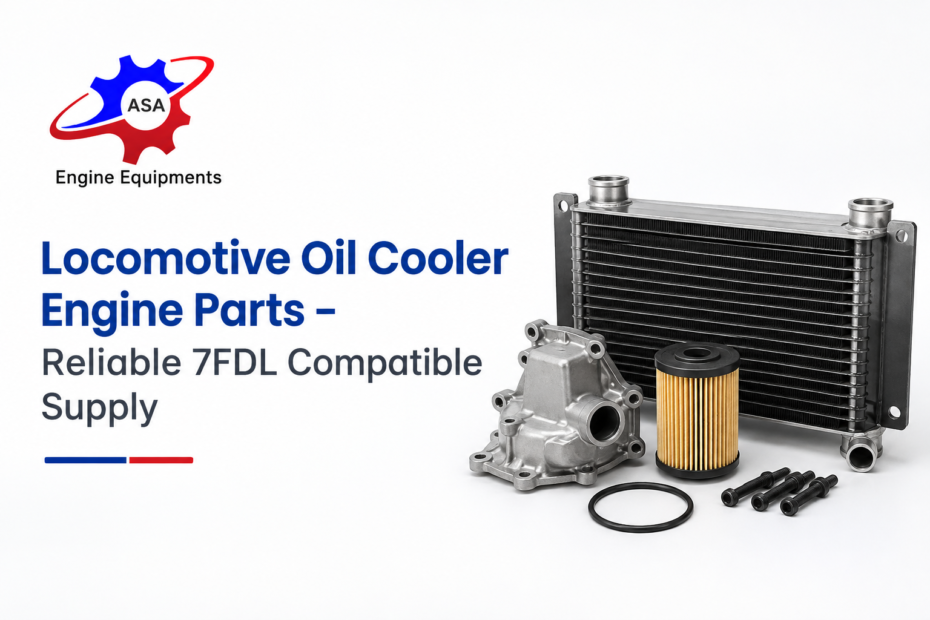
When a locomotive engine runs for thousands of hours under heavy load, heat management becomes just as important as fuel delivery or combustion efficiency. This is where Locomotive Oil Cooler Engine Parts play a critical role. A failing or inefficient oil cooler can lead to overheating, oil breakdown, and ultimately catastrophic engine damage — all of which translate into costly downtime for railroad operators, rebuilders, and marine fleet owners.
At ASA Engine Equipments, we supply OEM-equivalent Locomotive Oil Cooler Engine Parts engineered for GE 7FDL, EMD, and ALCO locomotive platforms. With over 20 years of experience serving railroad and marine industries worldwide, our components are built to the same tolerances and material standards as original equipment, giving operators a dependable, cost-effective alternative to OEM pricing and long lead times.
This guide covers everything you need to know about oil coolers in locomotive engines: how they work, why 7FDL compatibility matters, key specifications, installation and maintenance tips, and how to source dependable replacement oil cooler parts for your fleet.
What Is a Locomotive Oil Cooler and Why Does It Matter?
A locomotive oil cooler is a heat exchanger that removes excess heat from engine lubricating oil before it recirculates through the engine. As diesel engines like the GE 7FDL series operate under continuous heavy load, oil temperatures can rise rapidly. Without an efficient cooler, oil viscosity breaks down, lubrication weakens, and internal components such as bearings, pistons, and crankshafts face accelerated wear.
The Core Function of an Oil Cooler
The oil cooler works by circulating hot engine oil through a series of plates or tubes that are cooled by engine coolant or air. This process:
- Maintains oil viscosity within the optimal operating range
- Prevents oil oxidation and sludge formation
- Protects bearings, gears, and other high-friction components
- Extends overall engine service life
- Reduces the risk of unplanned shutdowns due to overheating
Common Oil Cooler Configurations
Locomotive oil coolers are typically available in plate-type and tube-and-shell designs. Each has distinct advantages depending on the engine platform:
- Plate-type coolers – compact, high thermal efficiency, commonly used in modern EMD and GE applications
- Tube-and-shell coolers – rugged construction, well suited for heavy-duty ALCO and older GE engines
- Bundle assemblies – modular cores that allow easier servicing and replacement without removing the entire housing
Why 7FDL Compatible Oil Cooler Parts Are Essential
The GE 7FDL engine family powers a significant share of the world’s freight and passenger locomotives, making 7FDL-compatible components some of the most in-demand locomotive engine parts in the aftermarket supply chain.
Engineering Precision for 7FDL Platforms
Our Locomotive Oil Cooler Engine Parts for 7FDL applications are manufactured to match OEM dimensional tolerances, ensuring:
- Correct flow rate and pressure drop across the cooler core
- Proper fitment with existing mounting brackets and gaskets
- Compatibility with factory coolant and oil circuits
- Consistent thermal performance across varying load conditions
Materials and Build Quality
Every oil cooler component we supply is manufactured using corrosion-resistant materials suited for continuous-duty railroad and marine environments. Core materials typically include:
- Copper-nickel or stainless-steel tube bundles for corrosion resistance
- Cast housings tested for pressure integrity
- High-temperature gaskets and seals rated for sustained thermal cycling
Key Specifications to Consider When Sourcing Oil Cooler Parts
Before ordering replacement components, operators and maintenance teams should verify the following specifications against their engine’s technical documentation:
- Engine model and horsepower rating (e.g., 7FDL8, 7FDL12, 7FDL16)
- Cooler core dimensions and mounting pattern
- Flow capacity (GPM) and pressure rating
- Material of construction (copper-nickel vs. stainless steel)
- Gasket and seal specifications
Matching these details precisely is essential, since even minor dimensional deviations can cause leaks, reduced cooling efficiency, or premature part failure.
Installation and Maintenance Best Practices
Proper installation and routine maintenance significantly extend the service life of Locomotive Oil Cooler Engine Parts. Below are practical guidelines drawn from decades of field experience supplying railroad and marine operators.
Installation Tips
- Always inspect mating surfaces for cleanliness before fitting a new cooler core
- Replace all gaskets and seals during installation — never reuse old ones
- Torque mounting bolts to manufacturer-specified values to avoid warping the housing
- Flush the oil and coolant circuits before commissioning the new component
- Pressure-test the assembly after installation to confirm there are no leaks
Maintenance Recommendations
- Monitor oil temperature gauges regularly for early signs of cooler inefficiency
- Schedule periodic cleaning to remove scale, sludge, or mineral buildup inside the core
- Inspect for external corrosion, especially in marine and coastal railroad applications
- Replace coolers showing reduced flow capacity rather than waiting for complete failure
- Keep maintenance logs to track cooler performance trends over time
Warning Signs of a Failing Oil Cooler
Operators should watch for these indicators, which often signal a deteriorating oil cooler:
- Rising oil temperature despite normal coolant temperature
- Visible oil-coolant mixing (milky coolant or oily residue)
- Reduced oil pressure at operating temperature
- External leaks around the cooler housing or gasket lines
Catching these signs early prevents secondary damage to bearings, turbochargers, and other lubrication-dependent components.
Why Choose ASA Engine Equipments for Oil Cooler Parts
Sourcing reliable Locomotive Oil Cooler Engine Parts requires a supplier who understands both the engineering demands of heavy-duty diesel engines and the logistics of global parts delivery. Here’s what sets ASA Engine Equipments apart:
- 20+ years of industry experience supplying parts for ALCO, EMD, and GE engines
- ISO 9001:2015 certified manufacturing and quality control processes
- OEM-equivalent quality at significantly lower cost than factory pricing
- 12-month warranty assurance against material or workmanship defects
- Global export capability to railroad and marine operators across the USA, Canada, Australia, Europe, and beyond
- Reverse engineering support for obsolete or hard-to-source components
Our team works directly with ISO-certified manufacturing partners, many of whom are approved suppliers to major OEMs, allowing us to deliver fully machined, quality-assured parts with dependable lead times.
Frequently Asked Questions
Are your oil cooler parts direct OEM replacements? Yes, our components are manufactured to match OEM specifications for fit, form, and function across 7FDL, EMD, and ALCO platforms.
Do you supply oil coolers for marine diesel engines as well? Yes, we supply locomotive-derived oil cooler assemblies for marine propulsion and power generation applications using the same engine families.
What is the typical lead time for oil cooler parts? Lead times vary by part complexity and destination, but our supply chain is optimized for faster turnaround than typical OEM channels.
Can you source parts that are no longer in production? Yes, through reverse engineering and our network of certified manufacturing partners, we can reproduce obsolete or hard-to-find components.
Final Thoughts
Reliable cooling is fundamental to locomotive engine longevity, and choosing the right Locomotive Oil Cooler Engine Parts protects your fleet from unnecessary downtime and expensive repairs. Whether you operate 7FDL-powered GE locomotives, EMD engines, or ALCO platforms, sourcing quality-assured, precisely engineered components makes a measurable difference in operational uptime.
ASA Engine Equipments combines two decades of industry expertise with rigorous quality standards to deliver dependable oil cooler solutions for railroad and marine operators worldwide. To discuss your specific engine model and cooler specifications, reach out to our team through asa-equipments.com for a quote tailored to your fleet’s requirements.