
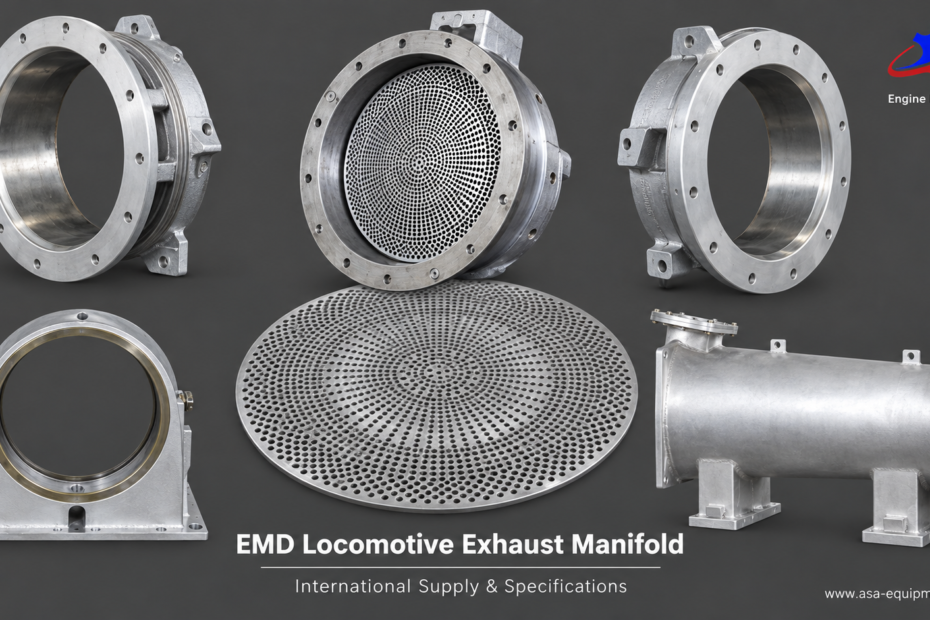
When it comes to keeping diesel-electric locomotives running efficiently under extreme heat and pressure, few components work as hard as the exhaust system. Among these, the EMD Locomotive Exhaust Manifold plays a critical role in channeling high-temperature exhaust gases safely away from the engine while withstanding constant thermal and vibrational stress. This guide covers everything you need to know about EMD exhaust manifolds — their construction, specifications, applications, maintenance, and international supply availability through ASA Engine Equipments.
What Is an EMD Locomotive Exhaust Manifold?
An EMD locomotive exhaust manifold is a fabricated exhaust manifold assembly that fits directly onto the exhaust outlets of GM (EMD) diesel engines. It collects exhaust gases from individual cylinders and guides them into a common exhaust chamber, and from there the turbocharger draws the gases before the locomotive releases them through its exhaust stack.
Unlike a simple pipe fitting, engineers build this component to survive a punishing operating environment — exhaust gas temperatures that regularly exceed 600°C, combined with continuous vibration, thermal cycling, and exposure to corrosive combustion by-products. Because of this, manifold design and material selection matter just as much as manufacturing precision.
Construction & Design
Manufacturers typically build the EMD locomotive exhaust manifold as a segmented, fabricated assembly rather than casting it as a single unit. This segmented approach offers several advantages:
- Modularity – Technicians can replace individual segments without discarding the entire assembly, which cuts maintenance cost and downtime.
- Flexibility under heat – Expansion joints between segments absorb thermal expansion and vibrational stress, preventing cracking and premature failure.
- Corrosion resistance – High-grade alloy steel construction withstands the corrosive atmosphere that sulfur compounds and other combustion residues create in diesel exhaust.
This design philosophy keeps the manifold assembly structurally sound even after thousands of operating hours in demanding railroad and marine environments.
Key Features
A well-engineered exhaust manifold assembly for EMD locomotives typically includes:
- Fabricated steel construction rated for continuous exposure above 600°C
- Segmented sections joined with expansion joints for thermal and vibrational stress absorption
- Precision-machined mounting flanges for a secure fit on exhaust outlets
- Compatibility across multiple horsepower ratings within the EMD engine family
- Corrosion-resistant coatings or alloys suited to long-term exhaust gas exposure
Technical Specifications
Exact dimensions and part numbers vary depending on the specific EMD engine model (such as the 567, 645, or 710 series), but most fabricated exhaust manifolds share common specification parameters:
| Specification | Detail |
|---|---|
| Application | GM (EMD) locomotive engines, multiple horsepower ratings |
| Operating Temperature | In excess of 600°C |
| Material | Fabricated alloy steel, corrosion-resistant |
| Design Type | Segmented assembly with expansion joints |
| Function | Directs exhaust gases from cylinder outlets to a common chamber |
| Stress Management | Expansion joints absorb thermal and vibrational loads |
These specifications suit the manifold not just for standard freight and passenger locomotives, but also for marine and stationary power applications that use EMD-derived engines.
Applications Across EMD Horsepower Ratings
One of the defining strengths of a properly engineered EMD Locomotive Exhaust Manifold lies in its adaptability. The same core design principles apply across different horsepower ratings within the GM (EMD) engine family, making it a versatile component for:
- Mainline freight locomotives
- Passenger and commuter rail locomotives
- Switching and yard locomotives
- Marine propulsion engines using EMD platforms
- Stationary power generation units built on EMD engine blocks
Because railroads and rebuilders often operate mixed fleets, having access to OEM quality parts that fit multiple horsepower configurations simplifies inventory management and reduces the need for highly specialized, model-specific stock.
Installation & Maintenance Tips
Proper installation and periodic maintenance significantly extend the service life of an exhaust manifold assembly. Key recommendations include:
- Inspect expansion joints regularly – These absorb most of the thermal and vibrational stress, so technicians should address early signs of cracking or looseness immediately.
- Check flange alignment during installation – Misalignment can create uneven stress distribution, accelerating wear.
- Monitor for exhaust leaks – Even small leaks can indicate a failing joint or corroded segment, and can affect turbocharger performance.
- Use OEM-equivalent replacement segments – Mixing incompatible materials or tolerances can compromise the entire assembly’s integrity.
- Schedule inspections around major overhaul intervals – Because the manifold operates continuously at extreme temperatures, operators should fold it into routine locomotive maintenance checks rather than waiting to inspect it after a failure.
Following these practices helps prevent unplanned downtime, which costs railroad operators dearly when they run tight scheduling windows.
Why Choose ASA Engine Equipments
ASA Engine Equipments has spent over two decades supplying OEM quality parts for ALCO, EMD, and GE locomotive engines to railroad operators, rebuilders, and marine industries worldwide. ISO 9001 / IATF 16949 certified manufacturing partners manufacture and source our EMD exhaust manifolds, which ensures consistent quality that meets or exceeds OEM standards.
What sets ASA Engine Equipments apart:
- Reverse engineering capability for hard-to-source or obsolete manifold designs
- Full engineering and manufacturing support across multiple certified production facilities
- Competitive pricing without compromising on material quality or manufacturing tolerances
- 12-month warranty assurance against faulty material or workmanship
- Reliable, on-time delivery backed by a proven quote-to-delivery process
Global Supply Coverage
ASA Engine Equipments supplies the EMD Locomotive Exhaust Manifold to railroad operators, rebuilders, and marine industries across the globe, including the USA, Canada, Australia, Bangladesh, Germany, France, the UK, Italy, Romania, Austria, Turkey, Mexico, Mozambique, Sri Lanka, Senegal, and the Republic of Liana.
This international reach reflects our commitment to being a dependable, one-stop source for locomotive exhaust system components — regardless of where a fleet operates or which EMD engine series it runs.
Conclusion
A dependable exhaust manifold is more than just a pipe — it’s a critical safety and performance component that must endure extreme heat, vibration, and corrosive exhaust gases without failure. Whether you’re maintaining a mainline freight fleet, a marine EMD propulsion system, or a stationary power unit, sourcing a properly engineered EMD Locomotive Exhaust Manifold ensures long-term reliability and reduced maintenance costs.
ASA Engine Equipments combines decades of industry experience, certified manufacturing partnerships, and global logistics capability to deliver OEM-equivalent exhaust manifolds wherever your operations are located.
Interested in sourcing EMD exhaust manifolds or other locomotive engine parts? Get in touch with ASA Engine Equipments today to discuss specifications, drawings, or sample-based custom manufacturing for your fleet.