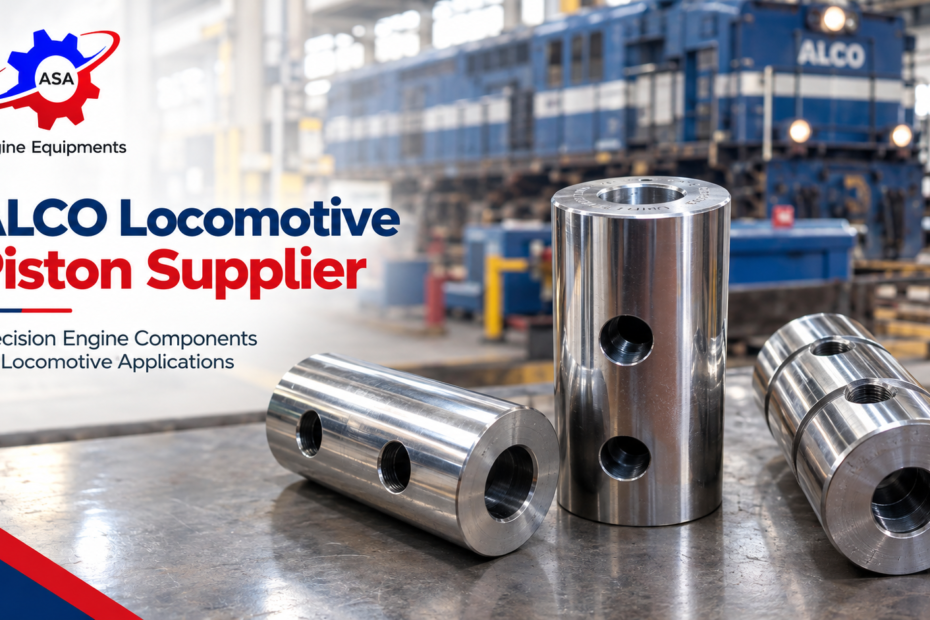
Diesel locomotives built on the ALCO (American Locomotive Company) platform remain in active service across railway, marine, and power generation industries worldwide. In fact, from freight yards in the USA to marine vessels in Europe and heavy-duty rail networks across Asia and Africa, these engines continue to run reliably decades after their original build. However, keeping them running smoothly depends on one critical component: the piston. Therefore, choosing the right ALCO Locomotive Piston Supplier can mean the difference between a costly unplanned shutdown and years of dependable engine performance.
In this guide, we break down the types of ALCO pistons available, their technical specifications, common applications, and, most importantly, what to look for when sourcing from an ALCO piston supplier you can trust.
What Is an ALCO Locomotive Piston?
The piston is essentially the heart of an ALCO diesel engine’s combustion process. Specifically, it moves inside the cylinder liner, converting the pressure generated by fuel combustion into mechanical motion that drives the connecting rod and crankshaft. Because ALCO engines are known for their rugged, high-torque design used in freight and marine applications, pistons must be engineered to withstand extreme heat, high compression, and continuous mechanical stress over long duty cycles.
As a result, a reliable ALCO locomotive piston supplier doesn’t just manufacture a part that fits — it delivers a component engineered to OEM tolerances, using metallurgy and heat-treatment processes that match or exceed original specifications.
Why Piston Quality Matters
A poorly manufactured piston, unfortunately, can lead to several serious problems:
- Loss of compression and reduced engine power
- Increased oil consumption
- Premature liner and ring wear
- Catastrophic engine failure in extreme cases
For this reason, railroad operators, rebuilders, and marine engine workshops consistently seek an ALCO diesel engine piston manufacturer with a proven quality track record rather than the cheapest available option.
Types of ALCO Locomotive Pistons
Not all ALCO pistons, however, are built the same. Depending on the engine series and application, pistons vary in design, material composition, and cooling method. Below, we outline the four main types you’ll encounter.
1. Cast Aluminum Alloy Pistons
First, cast aluminum alloy pistons are used widely in medium-horsepower ALCO engines. These offer excellent heat dissipation and, in addition, reduced reciprocating mass, which lowers stress on connecting rods and bearings.
2. Forged Steel Crown Pistons
Next, for high-horsepower ALCO locomotive and marine applications, forged steel crown pistons are generally preferred. These are typically two-piece or three-piece assemblies combining a steel crown — for heat and pressure resistance — with an aluminum or steel skirt for reduced weight and improved lubrication.
3. Oil-Cooled Pistons
Similarly, many ALCO engine pistons feature internal oil galleries or cooling channels that circulate lubricating oil through the piston crown. As a result, this helps manage the extreme combustion temperatures found in continuous-duty rail and marine engines.
4. Ring-Carrier Pistons
Finally, some ALCO piston designs incorporate a separate ring-carrier insert at the crown to resist wear from high-temperature combustion gases. Consequently, this extends piston life significantly in heavy-duty operation.
Overall, an experienced locomotive engine piston supplier will guide customers toward the correct piston type based on the specific ALCO engine model, horsepower rating, and application — whether railroad, marine, or stationary power.
Technical Specifications to Look for in ALCO Pistons
When evaluating an OEM ALCO piston parts supplier, buyers should, above all, confirm the following specifications:
- Material grade — Confirm alloy composition (aluminum-silicon alloys or forged steel) matches OEM standards.
- Bore diameter and tolerance — Precision machining within micron-level tolerances ensures proper fit with the cylinder liner.
- Compression height — This must match the connecting rod and crankshaft geometry for correct combustion chamber volume.
- Ring groove dimensions — Otherwise, improper groove sizing leads to premature ring wear or blow-by.
- Heat treatment process — Look for suppliers who apply proper hardening and stress-relieving processes to prevent cracking under thermal cycling.
- Weight balancing — Ideally, pistons should be weight-matched across a cylinder bank to reduce vibration and mechanical stress.
- Surface coating — Additionally, anti-friction coatings on skirts reduce wear during break-in and extend service life.
Ultimately, reputable suppliers manufacture and inspect parts in facilities certified to ISO 9001:2015 quality management standards. This ensures each piston batch is dimensionally consistent and defect-free before shipment.
Applications of ALCO Locomotive Pistons
ALCO engine pistons, meanwhile, are used across a wide range of industries and duty cycles. Below are the most common applications.
Railroad Operations
To begin with, freight and passenger locomotives running ALCO-designed engines rely on properly specified pistons to maintain horsepower output and fuel efficiency. This is especially true across demanding route profiles, including high-altitude and heavy-haul operations.
Marine Propulsion
Likewise, ALCO-derived diesel engines power a range of marine vessels, where pistons must handle continuous running hours, saltwater-influenced ambient conditions, and strict maintenance windows during dry-dock periods.
Power Generation
In addition, stationary ALCO diesel engines used for backup and industrial power generation also depend on durable piston assemblies capable of running for extended, uninterrupted periods.
Locomotive Rebuild & Overhaul Programs
Furthermore, rebuilders sourcing components for complete engine overhauls need a piston supplier offering full sets — pistons, rings, pins, and liners — matched and ready for assembly. As a result, this minimizes downtime during major maintenance events.
Why Choose ASA Engine Equipments as Your ALCO Locomotive Piston Supplier
ASA Engine Equipments, for example, has supplied OEM-quality locomotive and marine engine parts for over 20 years, serving railroad operators, rebuilders, and marine industries across the USA, Canada, Australia, Germany, France, UK, Bangladesh, Mexico, Italy, Romania, Austria, Turkey, Mozambique, Sri Lanka, Senegal, and more.
As a trusted ALCO Locomotive Piston Supplier, ASA Engine Equipments works with ISO 9001 / IATF 16949 certified Indian manufacturing partners — many of whom are approved suppliers to Indian Railways (DLW) — to deliver fully machined pistons that meet or exceed OEM specifications.
What Sets ASA Apart
- 20+ years of industry experience in ALCO, EMD, and GE locomotive parts supply
- OEM equivalent quality at competitive pricing, without compromising on material or tolerances
- 12-month warranty on all supplied parts against material or workmanship defects
- Reverse engineering capability for obsolete or hard-to-source ALCO piston variants
- Global export network with reliable lead times for railroad and marine customers worldwide
- Custom parts development based on customer drawings or physical samples
Our Process
Specifically, the ASA process follows four clear steps:
- First, the customer shares engine specifications, drawings, or sample parts.
- Next, ASA’s engineering team confirms compatibility and material specifications.
- Then, parts are manufactured and quality-checked by certified manufacturing partners.
- Finally, finished pistons are inspected, packed, and shipped with full documentation.
Maintenance Tips for ALCO Locomotive Pistons
To maximize piston service life once installed, consider the following best practices:
- Follow OEM-recommended lubrication intervals and oil specifications
- Monitor compression readings regularly to catch early signs of wear
- Inspect ring grooves and piston skirts during scheduled overhauls
- Replace pistons as matched sets across cylinder banks rather than individually
- Above all, source replacement parts only from a verified ALCO locomotive piston supplier to avoid dimensional mismatches
Conclusion
In short, selecting the right ALCO Locomotive Piston Supplier is a decision that directly affects engine reliability, maintenance costs, and operational uptime. Whether you’re a railroad operator managing a fleet, a rebuilder handling major overhauls, or a marine engineering team maintaining propulsion systems, sourcing precision-engineered, OEM-equivalent pistons is essential.
Ultimately, ASA Engine Equipments combines two decades of experience, ISO-certified manufacturing partnerships, and a global export network to deliver dependable ALCO locomotive pistons — backed by warranty and technical support — to customers across the railroad, marine, and power sectors.
Contact ASA Engine Equipments today to discuss your ALCO locomotive piston requirements and request a quote tailored to your engine specifications.